The Sacred Phallus
A contemporary ritual object for men who understand that honoring the body is not a solemn obligation — it is a celebration.
Discover Your Phallus Archetype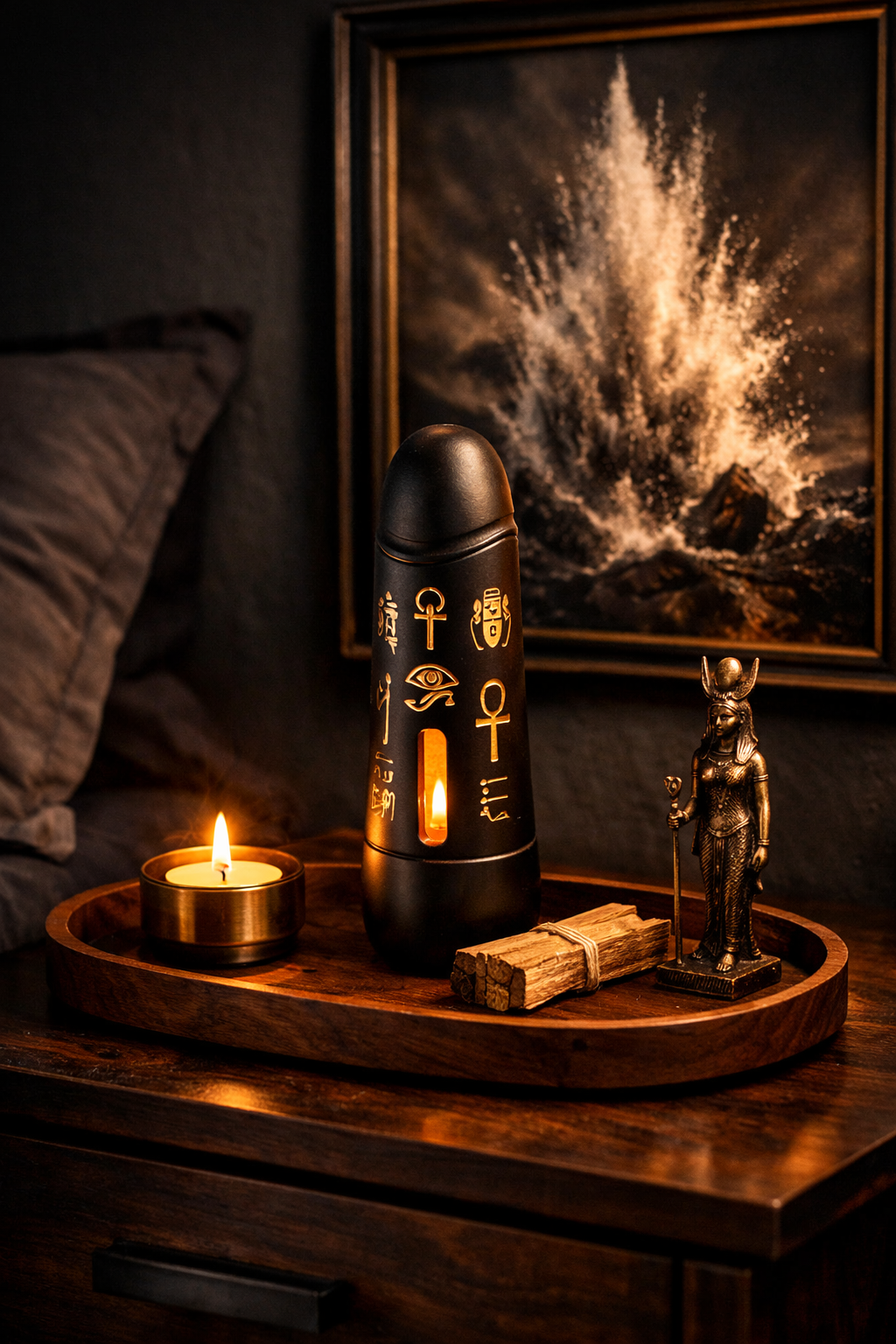
A contemporary ritual object for men who understand that honoring the body is not a solemn obligation — it is a celebration.
Discover Your Phallus Archetype
We are building a male sensory meditation device — a warm, whisper-quiet penile stimulator engineered for 30–60 minutes of slow, rhythmic sensation that trains a man to stay present in his body instead of rushing toward release. It uses body-temperature warming, breath-synced vibration patterns, and graduated session programs that guide the user through sustained arousal without the compulsive drive toward climax that characterizes most male sexual experience.
What the device actually does is simple: it holds a man in an extended state of pleasurable attention. The warming element brings the tissue to approximately body temperature, which relaxes the smooth muscle and increases blood flow without the urgency of direct mechanical stimulation. The vibration patterns are designed around typical breath cycles — four to six seconds in, four to six seconds out — so that a man who slows his breathing naturally entrains to the sensation rather than chasing it. The graduated programs begin at very low intensity and move upward over thirty or sixty minutes, training the nervous system to receive pleasure without immediately converting it into an ejaculatory reflex.
The clinical and psychological case for this kind of practice is well established. Slow, non-goal-oriented sexual stimulation activates the parasympathetic nervous system — the same branch engaged during meditation, deep prayer, and somatic bodywork. Men who practice extended non-ejaculatory arousal over weeks and months report changes consistent with the research: reduced performance anxiety, deeper interoceptive awareness — the ability to feel what is happening inside the body rather than only the surface sensation — and a recalibrated relationship between pleasure and presence.
The device is engineered for the man who meditates or wants to. For the man who has read enough about mindfulness to know that the body is the entry point and is tired of practices that ignore the one part of the body most charged with energy, shame, and potential. For the man who suspects that his relationship with his own pleasure has been shaped more by convenience and habit than by intention.
This is not a quick-release gadget. It is a dedicated ritual object — a contemporary altar piece that lives on your nightstand beside a candle and a lingam, not in a drawer where you hide it.
For most of human history, the phallus was not a private matter. It was a public one. Across ancient Egypt, Greece, Rome, India, Japan, and dozens of other cultures, the erect phallus was carved into temple walls, carried in festival processions, placed at crossroads as a protective charm, and offered at shrines as an act of gratitude and devotion. The phallus was understood as a force — generative, protective, sacred — that belonged not only to the individual man but to the community, the cosmos, and the divine.
In ancient Egypt, the god Min — depicted with an erect phallus and arm raised — presided over fertility, male sexuality, and the harvest. His festivals were among the most joyful in the Egyptian calendar: crowds gathered, music played, and the phallus was honoured both communally and in the intimate, private devotion of individual men. In Greece, the herm — a pillar topped with a head and bearing an erect phallus — stood at every doorway and crossroads. In Japan, the Hounen Matsuri festival still carries a enormous wooden phallus through the streets each spring, drawing thousands of participants who come not to be transgressive but to participate in a ritual of blessing that is older than most Western nations.
Today, most men are left alone with their pleasure — no ritual, no reverence, no guidance. The phallus was honoured both communally and in the intimate, private devotion of individual men. We're changing that.
What you are looking at is not a sex toy. It is a ritual object with a lineage stretching back to the earliest civilizations. The man who uses it in the spirit it is designed for — slowly, intentionally, with attention rather than urgency — is not doing something shameful. He is joining a tradition as old as the pyramids and as alive as the festivals that continue to this day.
The device is your invitation to join a brotherhood of men who understand that honoring the body is not a solemn obligation — it is a celebration. And you do not have to do it alone.
Join the procession — reserve your device.
Discover Your ArchetypeAnswer these questions to discover which archetype resonates with your current relationship to your body, your pleasure, and your practice.